Now that's a story!
Stories and more stories, sometimes true, often fictional, always written for your enjoyment.
List of audiobooks
The newest appears first.
Genre: Oriental Tale
1. The Land of Black
The story is part of the serie: Haft Peykar (The Seven Beauties)
The Indian Princess tells the story of a land where everyone wears black and lives in mourning. Every inhabitant has endured the same trial: standing on the threshold of perfect love, what was needed was patience and restraint.
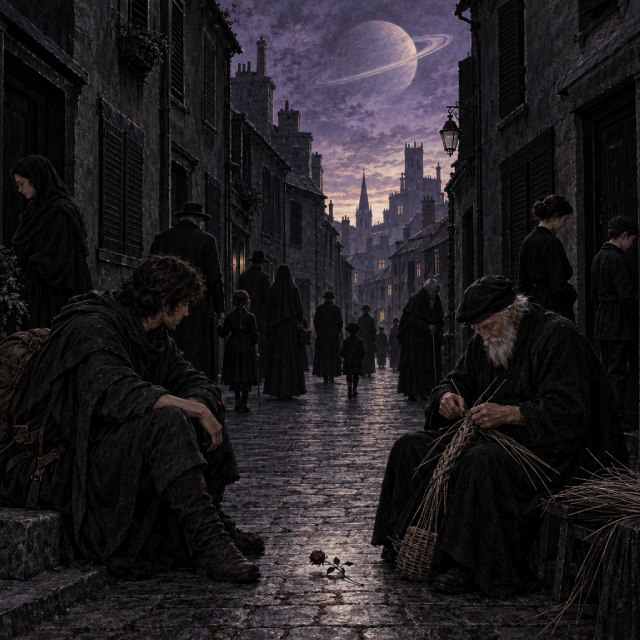
When the traveller passed through the city gates, he took it for a royal mourning. The men wore black, the women too, and the children, and the old people sitting on their doorsteps. Even the shutters were black. Only the dogs had kept their own coats.
"Whom have you lost?" he asked an old man who was plaiting rushes.
"All the same thing," the old man said without looking up. "Sit down, stranger. I'll start with myself."
He said that at twenty, one spring morning, he had come upon a garden nobody knew. At the far end, beside a pool, a woman sat combing her hair. He had never seen anything so complete. He understood that she was expecting him, and he understood the condition too, the way one understands things in a dream: he must not run, must not speak too quickly, must not reach out. He must sit in the grass, content to look at her, and let the day ripen.
"I held out until noon. Then a basket of fruit passed through the grass, and I wanted to eat. After that I picked a rose, because my hand was bored. When the sun began to sink, I decided I had waited long enough. I stood up and laid my hand on her shoulder."
The old man fell silent. His fingers kept plaiting.
"There was no shoulder any more. The pool, the garden, the scent, everything closed like an eyelid. I found myself in a stubble field with a withered rose in my hand."
The traveller took it for a peculiar madness. But from door to door he heard the same story, with other gardens, other fruits, other impatiences. Each of them had stood one step from perfection and had lost it through one gesture too many. Little by little the people of the city had recognized one another, first in their grief and then in their clothes, and had settled down together.
"The black isn't a punishment," a woman told the traveller. "It's a memory. It teaches us to hold on to what we have."
He left the next morning. On the road he saw ripe cherries on a bank. He did not pick them, and he was surprised at himself. He sat down, looked at them for a long time, and found that this was already something.

by Gabrielle Scouarnec (I am she)  learn more
Next publication on 2026-10-16 : Maeve, from Cork to Quebec