Judar Pacha
The Man who crossed the desert and never knew where to return.
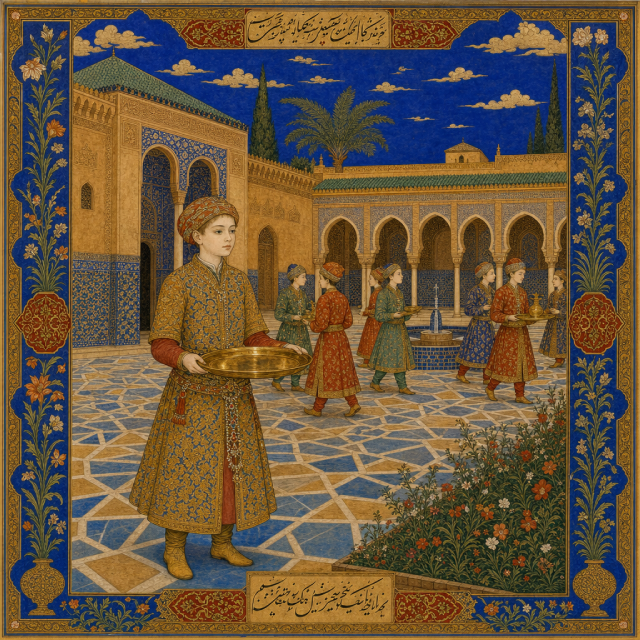
He was born in Cuevas del Almanzora, in the kingdom of Granada, around 1560 — which means he was born into a world already lost. The Reconquista had closed its jaws seventy years earlier, and the Moriscos survived in the humiliating in-between of suspect converts, too Arab for the Christians, too Christianized for themselves. His parents were captured during a Moroccan raid on the Andalusian coast, he with them, a child. He was taken to Marrakesh. They made him a palace page in the Saadian court, then a soldier, then an officer, then a general. This trajectory, which resembles an ascent, was first a sequence of uprootings.
Judar — likely a Hispanicization of Yūdar, itself an adaptation of Judas or perhaps simply the transliteration of a name that ceased to matter — grew up in the Makhzen's apartments learning to possess nothing. Not his mother's language, which he gradually forgot; not the Arabic he always spoke with an accent that drew smiles; not that pale face which marked him everywhere as strange. He became what Ottoman and Moroccan courts knew how to produce from uprooted children: a man of absolute loyalty to whoever had shaped him, precisely because he had no one else to be loyal to.
Ahmad al-Mansur chose him for this reason, among others.

In October 1590, Judar Pacha received command of an unprecedented expedition: cross the Sahara with an army of several thousand men — infantry, cavalry, camel drivers — and destroy the Songhai Empire, whose salt mines and gold routes represented a wealth the sultan had wanted to control for years. The enterprise was mad on paper. The desert between Marrakesh and the Niger ranked among the most hostile on earth. No foreign army had attempted this crossing at this scale. Judar was thirty years old, perhaps less.
It took him five months to reach the river. Moroccan chroniclers recorded the figures with the dry precision reserved for catastrophes: of the roughly ten thousand men who departed, barely half arrived. The rest died of thirst, of sand in the lungs, of scorpions, fevers, despair. Camels collapsed. Arquebuses rusted. Judar kept the column moving through a combination of cold discipline and what one might call, for lack of a better word, an indifference to suffering — his own included. The sources that survive say nothing of his emotions during this crossing. That silence may tell us everything.
On March 12, 1591, what remained of the Moroccan army met the forces of Askia Ishaq II at Tondibi, a few kilometers from Gao. The Songhai Empire fielded an infinitely larger army: cavalry, infantry, perhaps thousands of head of cattle meant to sow panic in the enemy ranks. The opposite occurred. The Moroccan arquebuses, a technology the Sahel did not yet know, turned the battle into a massacre within hours. The Askia fled. Gao fell. Timbuktu fell. Djenné fell. Judar Pacha, son of Andalusian captives, was master of the most coveted land in Africa.
He did not know what to do with it.
This is not a criticism — it is a historical observation. Judar sent envoys to al-Mansur with the initial spoils: gold, salt, slaves, ceremonial robes. He waited for instructions. He administered the conquered cities with a caution that resembled hesitation. He negotiated with Songhai dignitaries rather than massacring them, which earned him a recall from the sultan, who accused him of softness. Al-Mansur sent a replacement. Then another. The Moroccan Sudan, as these territories were now called, proved ungovernable: too distant, too vast, too foreign, resisting by sheer space any centralized administration.

Judar returned to Marrakesh. He was honored, given other commands, absorbed back into the Saadian military machinery. But the particular fate that had made him, for the duration of a crossing, the most extraordinary figure of his era, had closed. He died in 1606, in Marrakesh, in a city that was not his own, having overthrown an empire that was not his either, in the name of a sultan who had shaped him as one shapes an instrument.
What is strange, and worth saying, is that Judar Pacha is not a tragic figure in the classical sense. He does not struggle against his fate, does not curse it, does not attempt to overturn it. He crosses. Perhaps that is the only form of heroism available to a man who never had a home to defend — to keep moving, always, through sand or court, with the same economy of gesture, the same absence of any place where one might truly stop.
In Cuevas del Almanzora, today, a street bears his name. It is a small street.



