Quiet love
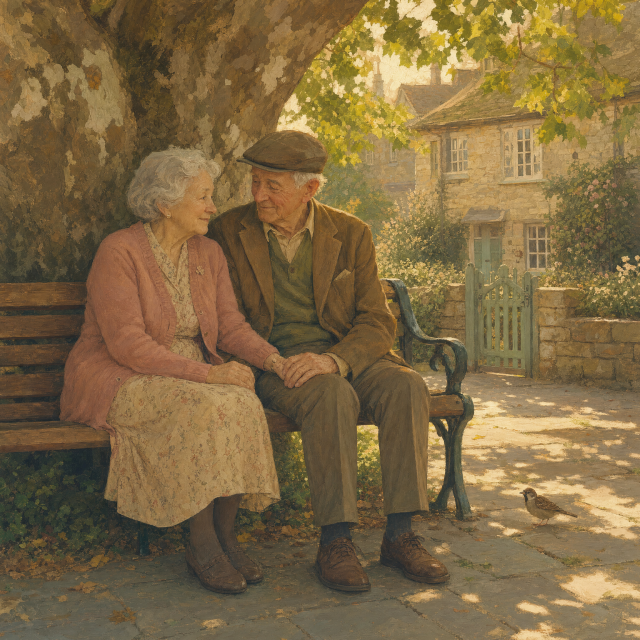
First they exchange a few words about the rain or the wind, then something tender and unexpected begins to grow — like those gardens that we think are asleep and that bloom again in the spring.
They first noticed each other in the same way people notice weather—gradually, in small changes rather than a single dramatic storm. Elsie saw him from her kitchen window the morning he came with a wheelbarrow and a toolbox, his hair more salt than pepper, his shoulders stooped by years of lifting and leaning. Arthur noticed the way she arranged her tea cups on the sill, how she left a paperback open on the bench outside as if saving a seat for the day.
Both had landed in the town after long chapters. Elsie, seventy-two, had been a school librarian and had carried the habit of organizing into her retirement: a neat row of seed packets, a labeled spice rack, a carefully kept calendar. Arthur, seventy-four, had been a carpenter; he smelled faintly of varnish and pine even after a shower and had the slow, exact gait of someone who measured twice before moving once. They were cautious people by necessity—marriages, the loss of parents, small betrayals—hands folded over histories they did not feel the need to spill all at once.
The first kindness was ordinary: Elsie’s lemon bars, warm from the oven, left on Arthur’s doorstep. He answered by tightening the loose hinge on her garden gate, leaving a strip of sanded wood and a scrap of polite handwriting: Thank you—for the bars. The exchanges that followed were equally prosaic and quietly deliberate. A borrowed book returned with a note tucked inside. A small thermos of tea set on the bench by the war memorial. Comments about the weather, about the price of eggs, about the stubborn geraniums that refused to bloom that year.
Conversation grew like moss—slow, green, and persistent. They sat one afternoon under the plane tree, and Elsie read aloud without meaning to, testing the cadence of her voice on an audience that listened. Arthur, who had never been much for words, listened in a way that made the old rhythms feel safe again. He told her how his wife used to press violets into letters. Elsie told Arthur about the time she’d convinced a fourth grader that reading could be an adventure. They shared stories with the kind of pauses that let each other in: the names of children and grandchildren always said with a little pride, the small embarrassments, the aches that arrived with salty mornings.
There were practical intimacies—the reaching for the same jar in the pantry and smiling when the other's fingers met theirs; the steadying hand on a wet step after a rain; the way Arthur unfolded a blanket and placed it across Elsie’s knees without asking, as if he had been practicing the gesture all his life. Neither introduced romance with fireworks. Instead, mutual care collected like change in a steady jar: a prescription picked up, a radio fixed, a potted plant bought “because it reminded me of you,” and left on the stoop.
One winter evening the town lost power. The streets grew dark; the usual hum of appliances went quiet. Arthur knocked on Elsie’s door with a lantern and a jar of soup. They ate from chipped bowls by lamplight, swapping stories and watching the candle like two people who had decided not to be alone that night.
Another day, someone put on a record—a slow waltz—and without announcing it, they rose and moved across the small rug, feet finding each other’s rhythm as if they had been practicing for years.
It wasn’t a declaration so much as a recognition. Arthur didn’t say, “I love you,” at least not in the florid way novels suggest. Instead, he learned the specificities of Elsie’s mornings: when she preferred her tea with milk, when she liked to be left in silence for the crossword, which roads made her knees protest. Elsie, in turn, learned the future shorthand for comfort—how Arthur would tense his jaw before telling a memory, how he always kissed the back of his hand when preparing to hammer a nail. Love, for them, became a collection of precise ministrations.
Their friends only noticed the changes you notice from the outside: an extra plate at the table, two pairs of slippers by the stove, and the way their laughter began to anchor the afternoons. The town council volunteers often saw them side by side, chatting about the garden club or the latest PTA book donations. Children waved and were waved back at, as if sensing an older rhythm of care.
On a spring afternoon, they sat on the bench where everything had begun and watched a sparrow hop between the paving stones. The sun softened the edges of their shadows. Elsie tucked her hand into Arthur’s—fingers warm, a little stiff, with small scars that had carved his life into the skin. He tightened his grip, a slow, deliberate pressure that said yes to all the tiny agreements they had made.
They did not promise forever —years teach you that forever is a hopeful measurement— but they promised one another the next Tuesday, the next cup of tea, the next quiet evening if the lights should ever go out again. That was enough. Their love lived in the ordinary: the shared bench, the fixed hinge, the record that kept turning. It grew into a comfortable habit of attention, a subtle reckoning that in the end, the most radical thing was to keep showing up.



