Long John Silver
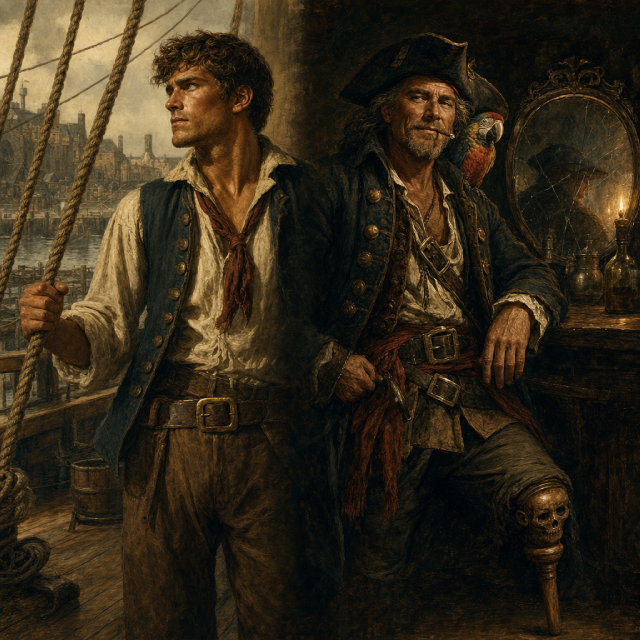
John Silver was not born to be a pirate, but when you sail the Caribbean Sea, you expose yourself to encounters that disrupt even the best-laid plans.
The Sailor from Bristol
John Silver was not born to be a pirate. In the morning mists of Bristol, around 1680, he learned ropes and knots on the Avon quays, son of a respected cooper who dreamed of a future for him in legitimate maritime trade. Tall and robust, endowed with keen intelligence and natural charisma, young John possessed that rare ability to make himself heard without raising his voice, to convince without threatening.
His first voyages were on merchant ships, transporting wool and tin to French and Spanish ports. He quickly climbed the ranks, progressing from cabin boy to sailor, then to quartermaster. His companions appreciated him for his loyalty and practical sense; captains, for his discipline and skill in maintaining order among the most unruly crews. John Silver was an accomplished seaman, respected, who seemed destined for an honorable career.
But the Caribbean Sea would change everything.
The Wound and the Revelation
It was in 1695, off Jamaica. The Mary Catherine, His Majesty's cargo ship carrying spices and gold, was attacked by three pirate vessels led by the fearsome Captain Edward Teach, he who would later be called Blackbeard. The battle was fierce and unequal. John Silver, then second mate of the Mary Catherine, fought with exemplary bravery, organizing the defense, rallying the terrified men.
It was in the final melee, as the pirates stormed the main deck, that a misdirected cannonball took his left leg below the knee. The pain was atrocious, but it was nothing compared to the humiliation that followed. Lying in his blood, watching his companions massacred or enslaved, John Silver understood a terrible truth: in these waters, the law was not that of the king, but that of the strongest and most cunning.
Blackbeard, impressed by the young officer's courage, spared his life. "You have guts, friend," he said, contemplating the wounded man. "Pity you serve the wrong masters." These words echoed long in Silver's mind during his convalescence in Port Royal. Lying on a hospital cot, painfully learning to walk with a makeshift crutch, he observed the comings and goings in the port. Pirates came there openly, spending without counting the gold they had stolen, both respected and feared.
The Metamorphosis
His wooden leg was carved from a piece of mahogany by a Jamaican carpenter who engraved, with macabre humor, a small skull on it. John Silver adopted it without bitterness, seeing it rather as a symbol of his rebirth. For that was indeed what it was: the former sailor, loyal and law-abiding, had died with his leg. The one who emerged from this ordeal was different, harder, more pragmatic.
He began by frequenting the disreputable taverns of Port Royal, listening to conversations, learning the codes and hierarchies of the pirate world. His intelligence and naval experience quickly earned him the attention of captains seeking competent men. But Silver did not want to be a simple pirate sailor; he had greater ambitions.
His first important prize was a Spanish galleon loaded with Mexican silver. Silver, who had become quartermaster on Captain Morgan's Revenge, had spotted the flaw in the escort and devised an attack plan of calculated audacity. The success was total, and his share of the booty allowed him to buy his first inn in Bristol, a respectable facade for his less avowable activities.
The Parrot and the Legend
It was in Tortuga that he found his famous parrot. The bird belonged to an old French buccaneer, Pierre le Borgne, who had just died in a brawl. The parrot, a macaw with brilliant colors, possessed an impressive vocabulary of curses in three languages and remarkable intelligence. Silver christened him Captain Flint, after the most feared pirate of his time, the one of whom it was said he had buried a fabulous treasure on a secret island.
The bird quickly became his trademark. Perched on his shoulder, it added to Silver's natural presence a theatrical dimension that impressed friends and enemies alike. "Pieces of eight! Pieces of eight!" cried the bird, and this phrase became like a leitmotif of his master's career.
For Silver was beginning to understand that being a pirate was not just about stealing and killing. It was about embodying a legend, becoming a character larger than life. He studied the great names of piracy, analyzing what made them successful: the terror inspired by Blackbeard, the audacity of Black Bart, the calculated cruelty of Charles Vane. But he wanted to be different. More subtle. More intelligent.
The Archetype in the Making
John Silver gradually developed his own method. Unlike his colleagues who were content to attack and plunder, he thought strategically. He understood that true wealth lay not in stolen treasures, but in the influence and network one could weave. His Bristol inn became an intelligence center where sailors, merchants, and royal officers crossed paths. There he gleaned precious information about ship movements, important cargoes, defense weaknesses.
His reputation grew in both worlds he now inhabited. In Bristol, he was John Silver, respected innkeeper, former sailor wounded in His Majesty's service. In the Caribbean, he was Long John Silver, the pirate with the wooden leg and parrot, the one who never let a treasure escape him and never lost a battle of wits.
He began to perceive, with troubling lucidity, that he was becoming something other than a simple pirate. Young buccaneers imitated him, adopting his expressions, copying his way of commanding. Tavern storytellers were already embellishing his exploits, transforming his victories into epics. He was becoming an archetype, the ideal pirate as popular imagination dreamed him: dangerous but seductive, cruel but loyal to his men, greedy for gold but capable of greatness.
The Consciousness of Myth
One evening in 1715, in his Bristol tavern, John Silver contemplated his reflection in the stained mirror behind the bar. Forty years old, graying beard, wooden leg, parrot on his shoulder. He looked exactly like the image one had of a pirate, and this resemblance was not fortuitous. He had cultivated it, refined it, transformed it into a weapon of seduction and intimidation.
Captain Flint tilted his head and murmured, as if reading his thoughts: "Pieces of eight, John. Pieces of eight."
Silver smiled. He knew he had created something that surpassed him. In a few years, a few decades perhaps, when his true story would be forgotten, there would remain the character he had forged. And perhaps one day, a talented storyteller would transform his legend into an immortal story.
He did not suspect that a young Scottish writer named Robert Louis Stevenson would soon cross his path, nor that their meeting would give birth to one of literature's most famous adventures. But already, Long John Silver existed fully, accomplished archetype of the romantic pirate, ready to sail toward immortality.



