Discord behind the scenes
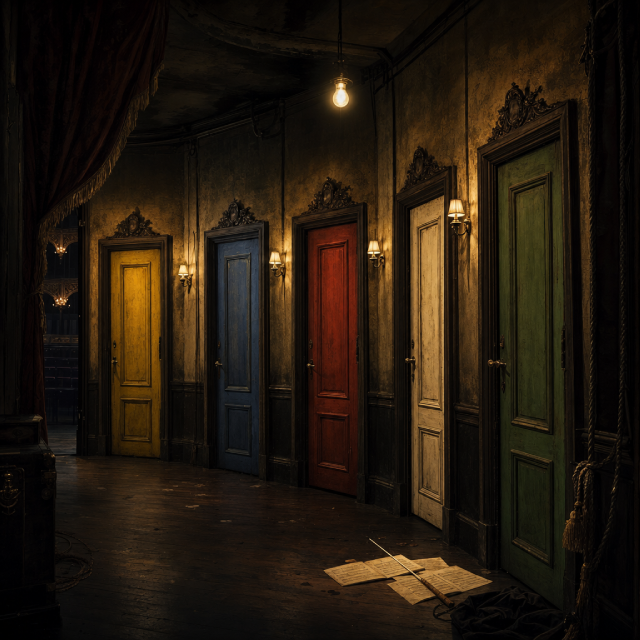
A murder has been committed in a theatre. Use the clues to identify the culprit.
I. The Discovery
The Ormes Theatre still smelled of waxed wood and rosin dust, but that evening another odor had crept in — metallic, cold, unforgiving. Colin Meunier lay on his side, in the small rehearsal room adjoining the dressing rooms, a crumpled score beneath his right hand, as though until the very last instant he had wanted to cling to something familiar. A music stand, knocked over near the door, completed the scene’s air of an interrupted tableau.
Colin was not a musician. He coordinated the tours, the hotels, the transport — the man in the shadows without whom no orchestra travels, and without whom, too, no one notices much of anything until the day he is missing. It was a dresser who had found him, twenty minutes before the first musicians arrived for the evening’s warm-up. She had screamed once, then fallen silent, as though the theatre’s own silence had ordered her to be quiet.
Bertrand Moreau, conductor for twenty-two years, was first on the scene — even before the police, whom he himself had called. He stood motionless on the threshold for a long moment, his baton still tucked into his jacket’s inner pocket, like some absurd reflex. The gala concert — Bizet, Handel, a little Bach for the encore — was to take place in forty-eight hours. The orchestra would then leave on tour. If the affair dragged on, if the press got hold of it, if the musicians were summoned one by one to a police station for days on end, the entire season would collapse.
“I’ll take care of this,” he told the inspector who had come to examine the scene, with an authority that brooked no argument — the very same authority he used to discipline a hundred and twenty musicians with a single flick of the wrist. “I know them. You don’t.”
The inspector, a tired man who already had more than enough case files, did not argue for long. He agreed to let the conductor conduct his own questioning, on condition that everything be reported to him by the end of the week.
Bertrand went back down to the performers’ corridor, the one they called among themselves “the corridor of the five doors.” Five individual dressing rooms lined it, sober and identical in their proportions, but each recognizable by the color of its door: yellow, blue, red, white, green, in that order, from the back of the corridor to the exit on the stage-left side. Five musicians. Five doors. And, somewhere behind one of them, he thought with a dizziness he allowed himself only for an instant, an answer.
II. The Yellow Door
He began at the end of the corridor, where the yellow door closed off the most remote dressing room — the quietest one too, traditionally assigned to the first violin. Claire was already there, sitting very upright before her mirror, her bow laid across her knees like a talisman.
Claire was not the type to fall apart. She had that slightly dry elegance of soloists who have learned, very young, to contain their emotions so as never to disturb the music. On her dressing table, Bertrand noticed a music stand slightly displaced from its usual spot — bumped, no doubt, by a hurried hand on some rehearsal evening. Nothing alarming: these too-tall, too-unstable pieces of furniture get jostled a hundred times a week. He paid it only distracted attention.
“You know why I’m here, Claire.” “I imagine so.” She did not raise her eyes. “You want to know where I was, what I was doing, what I saw.” “For a start, yes.”
She recounted her evening without apparent evasion: she had spent most of her time in the orchestra pit, alone, working through a treacherous passage in the score that had been tormenting her for weeks — a technical challenge she did not want to speak of to anyone before she was sure she had mastered it. She confirmed, almost with a quiet flicker of pride, that she did indeed occupy that back dressing room, the one with the yellow door — the quietest of them all, she said, the one where she could still hear Mozart singing in her head without anything disturbing her. For it was indeed Mozart whom she had worshipped since childhood, since a record played on repeat at her grandmother’s, long before she knew how to hold a bow.
Bertrand noted, as he left her, a detail that only struck him later in the corridor: that back dressing room, the most remote of all those in the corridor, was also, by construction, the leftmost dressing room when one looked down the corridor from the performers’ entrance. And it was precisely there, at the far left, that the Mozart admirer’s door closed each evening.
III. The Blue Door
The neighboring dressing room, with the blue door, belonged to Frank, the pianist — an ordinarily jovial man, but who, that evening, was putting away, with unusual nervousness, scores covered in red-pencil annotations, whole measures crossed out and redone. A difficult accompaniment, he explained with a shrug, nothing more than a disagreement with his own score.
“How did things go between you and Colin?” “Same as with everyone. He booked my trains, my hotel rooms. We didn’t talk much beyond that.” He gave a short, bitter laugh. “Those who know me will tell you I’m resentful by nature — I never forget a bad tempo imposed by a conductor, nor a wrong note pointed out in front of the whole section.” He added, almost confidentially, that Beethoven had been his favorite composer since the conservatory, that deaf and furious Beethoven who seemed to have written his music against the whole world rather than for it.
He had spent the evening, he said, up in the first balcony, watching the empty hall fill up little by little in his imagination, a habit he kept up before every big concert — sitting where the audience would be, to guess what they would hear.
Bertrand closed the blue door behind him and lingered a moment in the corridor, his mind cluttered with a connection that would not let go of him: this blue dressing room stood directly next to Claire’s, the Mozart admirer’s. Coincidence of neighboring rooms, or a detail that mattered? He could not yet say.
IV. The Red Door
In the middle of the corridor — exactly in the middle, like the pivot of a scale — stood the red door. It was the most richly furnished of the five dressing rooms, Bertrand noticed as he entered: a padded armchair the others did not have, a gilt-framed mirror, a small shelf lined with leather-bound scores. Damien, the cellist, kept there a metronome that had stopped, it seemed, days ago — broken, no doubt, Bertrand thought, or simply forgotten.
Damien had that somewhat heavy calm of cellists, that way of speaking slowly as though saving his breath for the bow. He said he had spent the evening wandering among the seats in the stalls, a habit he had kept from his conservatory teacher: “You must sit where the listener will sit,” he used to say, “to hear what the orchestra will really make them hear.” So he had walked row by row, alone in the darkened hall, well before the drama broke out in the dressing-room wing.
Asked about his tastes, he admitted, with an almost embarrassed half-smile, an unwavering devotion to Bach — the rigor, the architecture, he said, “everything that never collapses, even when everything else is shaking.” Bertrand noted, without showing it, that it was precisely behind this red door, his own, that the Bach devotee lodged.
He also noticed, on leaving this dressing room, too plush for a mere orchestra cellist, something that troubled him more than the stopped metronome: this middle room, with its almost improper comfort, smelled more of covetousness than of music. As though someone here had always wanted a little more than what they were given.
V. The White Door
The fourth dressing room, with the white door, belonged to Julien, the flutist. Bertrand found him sitting on the floor, back against the wall, a broken reed between his fingers — a banal accident, wood that cracks, nothing that doesn’t happen ten times a season to any nervous wind player.
Julien had drawn features, red eyes, and a voice that trembled slightly as he spoke — less from grief, it seemed to Bertrand, than from anger held in for too long. He confirmed without hesitation that he had spent the evening in the corridor itself, pacing back and forth in front of the dressing rooms, unable to stay still. Asked about Colin, he stiffened:
“I have nothing to say about Colin.” “That’s not what I’m asking, Julien. I’m asking for your favorite composer.” “Handel.” He almost spat the name. “Always been Handel.”
Bertrand did not press further, but as he closed the white door he sensed something acrid hanging in that dressing room — an almost palpable jealousy, though he could not tell whether it targeted Colin, a fellow musician, or simply the fate that seemed to have been dogging this taciturn young man for months.
VI. The Green Door
The fifth and last dressing room, the one at the far end on the stage-left side, opened behind a green door — immediately to the right of Julien’s white door, so much so that the two musicians had only to reach out to touch shoulders through the wall. It was Aline’s dressing room, the percussionist.
A forgotten mute lay on the windowsill. In a corner, a broken cello string — mislaid there somehow, no doubt brought back by mistake from another dressing room during some borrowed instrument. A little rosin powdered the carpet, in a spot where no bow had any reason to be. So many details which, taken alone, told nothing — clues that seemed to belong to everyone and no one, as though this dressing room gathered up the forgotten debris of the whole corridor.
Aline was strangely silent about how she had spent her evening. She mentioned, in an unsteady voice, “corridors, dressing rooms, here and there,” without ever specifying where she really was at the moment of the drama — a vague wandering she could not, or would not, make any more precise, whatever efforts Bertrand made to get her to talk.
“And your composer, Aline?” “Bizet.” For the first time in the interview, she gave a genuine smile, almost pained. “Always has been.”
Bertrand then remembered, as he left, that it was precisely the orchestra’s percussionist who held such devotion for Bizet — and he lingered a moment on the threshold of the green door, not quite sure what, in that untidy dressing room and that too-careful silence, troubled him more than everything else.
VII. Claire’s Silence
It was late in the evening, as Bertrand was gathering his notes and preparing to leave the theatre, that he crossed paths again with Claire in the now-empty corridor. She seemed to be waiting for him, leaning against the wall near her yellow door, arms crossed.
“Bertrand.” “Claire?” “Colin and Aline…” She stopped short, bit her lip, seemed to struggle with herself. Then, all at once, she closed the door she had just begun to open onto herself: “No. It’s none of my business. Good night.”
She disappeared into her dressing room without another word, leaving Bertrand alone in the corridor of the five doors, with the chilling certainty that she knew — or at least guessed — something she had chosen to keep silent. Out of loyalty to a friend, he thought. Or out of fear of what the truth might destroy, or reveal.
VIII. The Conductor’s Night
Bertrand went home that night empty-handed and full-headed. He spread his notes over his kitchen table, in the disorder of words he had not had time to sort out: five doors, five composers, five motives, five locations where each claimed to have been while Colin Meunier drew his last breath in a rehearsal room that smelled of dust and cold.
He thought back to the displaced music stand at Claire’s, to the broken reed at Julien’s, to the mislaid cello string at Aline’s, to the stopped metronome at Damien’s, to the crossed-out scores of Frank’s — all those small everyday accidents of an orchestra’s life, which proved nothing and yet, all the same, obsessed him as though they had to mean something.
Above all, he thought back to what he knew for certain: the Bach lover’s door was red. The Bizet specialist played percussion. The Handel lover paced the corridor at the time of the drama. The green door, the one belonging to unhappy love, opened immediately to the right of the white door. The Beethoven lover claimed to be driven by revenge. The cellist haunted the seats in the stalls. The first violin stood behind the yellow door. It was behind the middle door that greed was cultivated. The far-left door belonged to the Mozart admirer. The pianist lodged right next to the one who had spent the evening in the orchestra pit. The first violin’s dressing room stood next to that of the musician who watched from the first balcony. The flutist, for his part, was consumed by jealousy. And the Mozart admirer’s dressing room stood right next to the blue door.
Five doors. Five truths intertwined like the voices of a fugue. One of them, he was now certain, concealed a murderer.
The gala concert would take place in forty-eight hours. It remained to be seen whether, that night, all the chairs would still be filled — or whether one of the five musicians would play his last measure somewhere other than on that stage.



