II-The Bobo's Armor
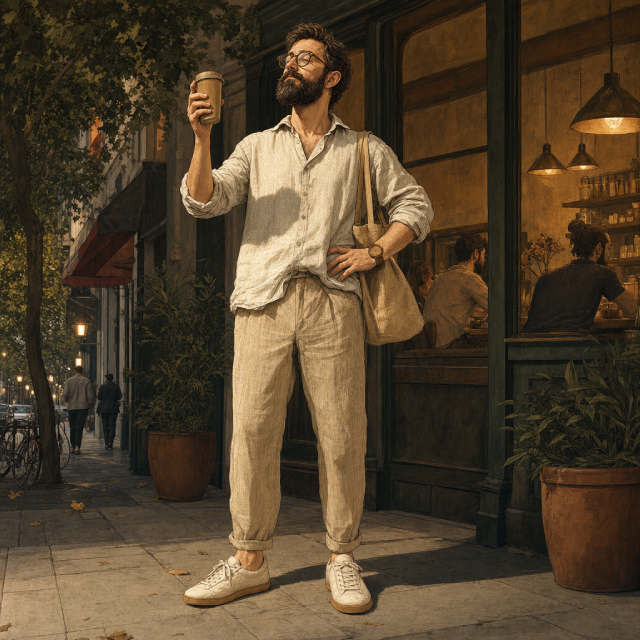
When appearance goes beyond appearances.
Bogdan de Bobigny did not dress. He clothed himself in intentions. His style was a philosophy worn on the body. He wore a linen shirt "grown without irrigation," hemp trousers "dyed with local plants," natural rubber sneakers "made in a Portuguese cooperative." Every piece had been selected after hours of research, carbon-footprint comparisons, readings of GOTS, Oeko-Tex, or Fair Wear certifications. The whole ensemble, assembled with a consummate art of "controlled deconstruction," gave the impression of radical simplicity. And yet this simplicity came at a cost. A steep one. But Bogdan never spoke of price. He spoke of "value," of "sustainability," of "traceability." He had even created an Excel spreadsheet to track the environmental footprint of each garment, a spreadsheet he happily displayed at cocktail parties, not without a touch of modest pride.
His beard, trimmed to the millimeter yet deliberately left "a bit wild," was maintained with an oil based on organic jojoba and wild rosemary. His hair, styled in an "intentionally tousled cut," knew neither silicone nor sulfate. He refused classic barbershops, preferring "conscious" salons where they asked your zodiac sign before picking up the clippers. He wore glasses with recycled-acetate frames, an "upcycled" jute canvas bag, and an olive-wood watch whose hands, it was said, moved "at the rhythm of nature." In reality, it lost four minutes every week, but Bogdan claimed this was a "poetic correction" against the tyranny of industrial time.
The most remarkable thing was that he lived out this outfit like a suit of combat armor. He saw himself as a soldier of the transition, a scout of the post-growth era, a pioneer of "slow living." He walked the streets with a measured, almost ritual gait, as if treading on sacred ground. He greeted local shopkeepers with a diplomat's gravity, exchanged smiles with cyclists, and carefully avoided the gazes of Uber Eats couriers. He had a way of holding his recycled cardboard cup — never plastic, never an unnecessary lid — that resembled a blessing. And when he sat down on a café terrace, he never ordered a plain coffee, but a "oat-milk flat white, no sugar, in a reusable cup, with a note on the bean's origin." All of it delivered in a soft, measured voice, as though reciting a secular prayer.
His friends said he had "the style of a Zen monk who'd gone to a top political-science school." He would reply with a smile: "I'm not trying to be seen. I'm trying to be coherent." The phrase, repeated like a mantra, perfectly summed up the Bogdanian art of self-persuasion. He believed in his own legend, and it was precisely that belief that made it real for everyone else.



