III. The Contemporary Cabinet of Curiosities
The reliquary of commitment
His study was not a museum of exotic weapons, animal hides, rusty sabers, and travel tales. Bogdan de Bobigny lived in the universe of conscious consumption. His living room was not a place of rest, but a living gallery of his commitment.
On a raw-wood shelf, mounted with brackets forged by a blacksmith from the Périgord, sat books with evocative titles: Decolonizing Ecology, The Myth of Green Growth, Rooting Oneself in the Living World, Manifesto for a Joyful Sobriety. Beside them, non-recycled Moleskine notebooks (an "admitted lapse," he explained, "for the quality of the paper"), hiking guides for "off the beaten path," and a stack of pamphlets on ZADs (Zones to Defend), community-supported farms, and local currencies. He rarely read them cover to cover, but he quoted them with precision, always specifying the author, publication date, and context of writing.
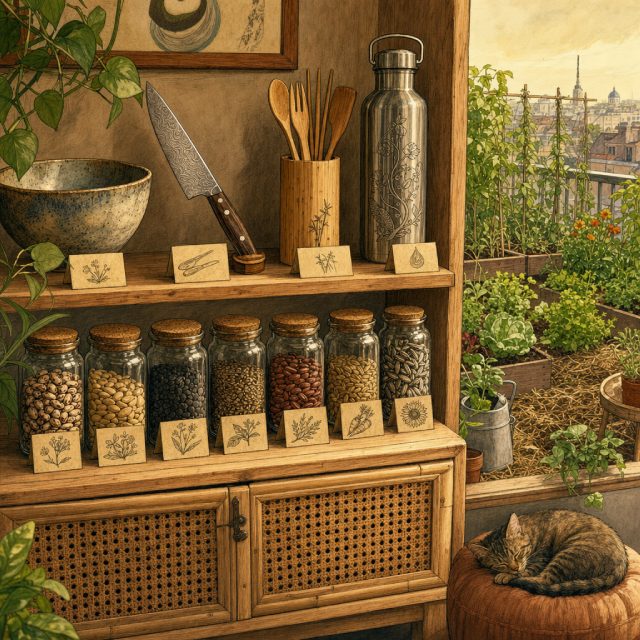
In a low rattan cabinet, he kept his "objects with a story": a stoneware bowl bought during an "immersive weekend in the Cévennes," a Damascus-steel kitchen knife forged by a former metallurgist turned "free" craftsman, a set of bamboo cutlery "gifted by a community of digital nomads in Morocco," a stainless-steel water bottle engraved with a Celtic symbol "to remind us of our bond with the Earth." Each object came with a small handwritten card explaining its provenance, its manufacturing conditions, and its estimated carbon impact. Bogdan handled them with an almost religious tenderness. He showed them off during visits, turned them over in his hands, murmured details about the potter, the blacksmith, the weaver, as if he had shared their lives for months.
He also owned a seed collection. Not just any seeds: heirloom varieties, forgotten vegetables, pollinator flowers, medicinal herbs. They were kept in hand-labeled glass jars, sorted by climate, by season, by use. He spoke of "food resilience," of "seed sovereignty," of "the memory of living things." He had even set up a small permaculture patch on his balcony, with raised beds, hemp mulch, and a rainwater-harvesting system connected to an app that measured humidity levels. The garden actually produced three cherry tomatoes and one basil plant a year. But Bogdan presented it as a "self-sufficient ecosystem," a "living proof that one can rebuild a bond with the soil, even in the city."
His study was not a museum of the past, but an altar to the future. There he displayed not hunting trophies, but relics of commitment. And like his Tarascon-born ancestor, he drew from it his stories, his metaphors, his legitimacy. He did not collect to possess. He collected to narrate. And that, perhaps, was the very heart of the character: a man who turned objects into stories, stories into identity, and identity into virtue.



