The Legend of the Divine Birds and Water Spirits
Creation by birds is not an act of will, but a mutual recognition between things that were waiting to be named.
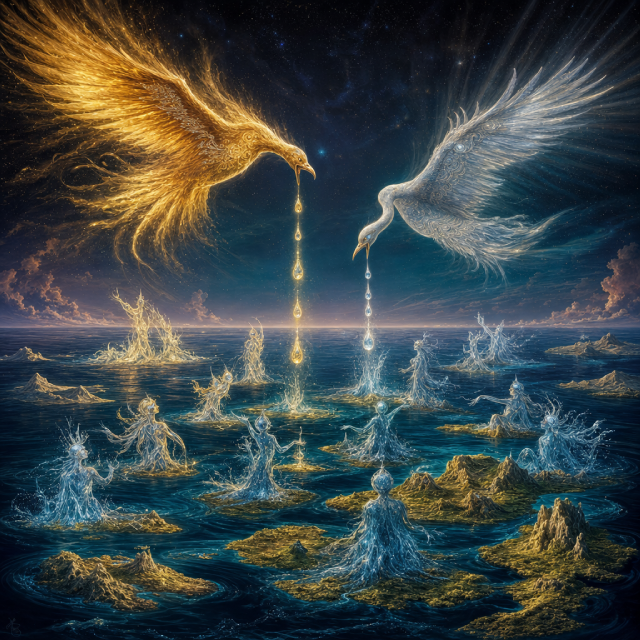
In the beginning, there was only the primordial ocean, dark and without shores. Then, from nothingness, two divine birds emerged, their feathers shining like gold and silver. They flew above the abyss, and from their beaks fell drops of celestial dew. Upon touching the water, those drops awakened into water spirits — luminous, fluid creatures who sculpted the first lands. The birds sang a hymn of creation, and wherever their voices carried, life burst forth, uniting sky and sea in an eternal dance.
This image — two birds suspended above the original void, seeding the world with sacred dew — is among the most powerful and widespread in Siberian and Eurasian mythologies. It belongs to a body of stories that ethnologists call the cosmogonic dive myth, a tradition whose roots plunge into the deepest strata of human memory. Peoples as diverse as the Buryats, the Evenks, the Nenets, and the Yakuts share, in varying forms, this vision of a world born from water and sky, shaped by winged beings whose nature belongs as much to the divine as to the shamanic.
The two birds are no ordinary creatures. In most variants of this myth, they embody a founding duality: one represents light, the solar breath, the upward impulse; the other carries mystery, lunar depth, the call of the waters. Together they form the primordial pair that makes creation possible — not through opposition, but through complementarity. Their feathers of gold and silver are not mere adornment; they are the first manifestations of light in a world that had not yet known it, the first sparks of a cosmos learning to exist.
When they flew above the abyss, there was at first only silence. A total, absolute silence, so deep it contained within itself all the music yet to come. Then came the movement of their wings — a single, solemn beat, like the universe's first heartbeat. And the drops fell. Tiny, almost invisible, they touched the black surface of the primordial ocean, and something irreversible began.
For these were no ordinary drops of water. They were celestial dew — Su Ene in certain Turco-Mongolic languages, the Mother of Waters — a substance midway between matter and spirit, charged with the breath of the heights. Upon touching the ocean, they did not dissolve; they awakened. They became water spirits: the Suu Ezi, the invisible masters of rivers, lakes, and seas — fluid, luminous entities that Siberian shamans honored with offerings of white furs and mare's milk.
These spirits were not passive creatures. They had a task: to sculpt the first lands. And here the myth reveals its full geological and spiritual depth. In the Siberian worldview, the earth is not a creation ex nihilo, drawn from nothingness by an omnipotent god. It is the result of collaboration: the divine birds carry down from the sky the raw material of life, and the water spirits give it form, kneading and shaping it with their immaterial bodies. Certain versions of the myth specify that the water spirits dove to the bottom of the ocean to bring up sacred mud — the world's first clay — which they then deposited on the surface to form the continents.
Then came the song. And this may be the most beautiful and most extraordinary dimension of this legend. The two birds did not merely create through the physical act of flying or releasing drops; they sang. Their voices were a cosmic force unto themselves, a vibration so deep it passed through matter and spirit without distinction. Wherever this song reached, life responded: grasses grew on the newly formed lands, fish were born in the waters, insects hummed in the still-fresh air of creation. Sound preceded form; the word summoned existence. Here one finds a striking echo with other great traditions: the Word that precedes the world in Judeo-Christian cosmology, the primordial Om of Vedism, the Hum of Tibetan cosmogonies. The creative voice is universal, but nowhere is it as embodied, as visceral, as tied to the natural world as in these Siberian myths, where it issues from the beak of a bird in flight.
Within the shamanic tradition surrounding this myth, the divine birds did not vanish after creation. They transformed. Some Siberian shamans claimed that their tüngor — their guardian spirit, their winged double — was one of these primordial birds, incapable of dying because it had preceded death itself. Siberian shamanism overflows with avian figures: the shaman in trance wears a coat of feathers, his drum mimics the beat of wings, his spiritual journey toward the celestial heights reenacts the original flight of these two luminous beings. The bird is the mediator par excellence — the one who crosses the boundary between the visible and the invisible, between this world and the other.
The water spirits, for their part, remained. Invisible but present, they continued to watch over the rivers, lakes, and seas they had helped fashion. The riverside peoples of Siberia knew that before crossing a body of water, one had to speak to it — not pray as to a god, but greet it as an ancestor, as a being who had preceded humanity and deserved, for that reason, both respect and gratitude. A scrap of white fur laid upon the surface, a few words murmured in the ancient tongue, and the crossing became safe. The spirit had heard.
Even today, in certain remote villages of Siberia, Yakutia, or Buryatia, elders still know what to say to a river before they cross it. They know that water remembers. That the birds of gold and silver have not flown away forever. That they circle somewhere beyond the horizon, where sky meets sea, waiting for humanity to find enough silence to hear their song again.



