Murder in the Wine Cellar
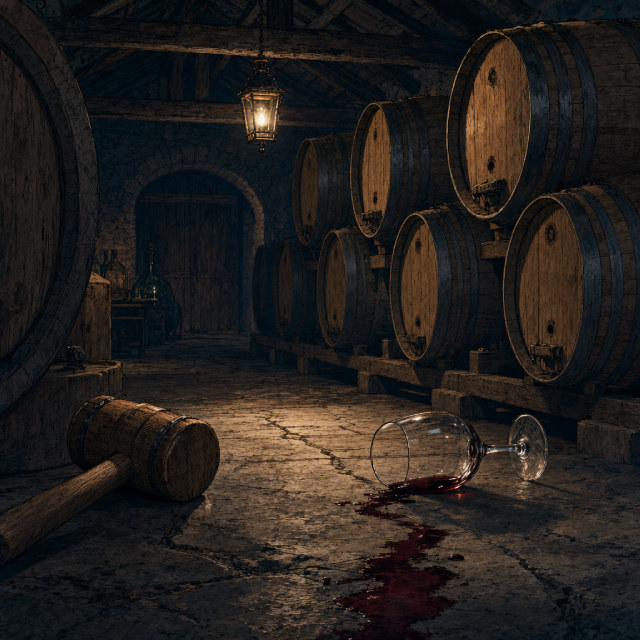
Everything is in this story. Every clue, every detail, every sharpened denial. The false trails collapse one after another when you coldly follow the logical thread.
Who killed the master of the cellar? Where? With what? And why?
I — The Grey Morning
Autumn weighed upon the estate like a shroud of mist. The grape harvest had just ended, and with it, a life. They found the master of the cellar lifeless one November morning, somewhere among the vats and the barrels — his face frozen in a surprise it would never shed again. The gendarmerie concluded it was a heart attack. But Inspector Vasseur smelled murder the moment she noticed the scratch marks on the doorframe of the press room.
Five people, that evening, each had a reason to commit the fatal deed.
II — The Five Shadows of the Estate
They were all known at the château. Familiar figures, silhouettes circling the vats like moths around a lamp.
Mr. Cognac, the estate manager, a man who rummaged through the domain's past, passionate about old objects — said to collect antique blades and forgotten tales.
Mr. Whisky, the neighbour, whose disputes with the master of the cellar went back ten years. It was whispered he carried a wound in his heart that neither time nor wine had been able to heal.
Mr. Rum, the distant cousin, always a little too present when inheritances were concerned. He had reread the will six times since Easter.
Mrs. Vodka, the oenologist, slender and fragile, whose hand could scarcely lift more than a tasting glass. A woman of science, she said. A woman of grudges, others said.
And then Mr. Tequila, the journalist who had come to cover the grape harvest and stayed long after the article was published. He roamed the buildings with overly curious eyes and overly long fingers.
III — What Each One Swore
Inspector Vasseur summoned them one by one, into the small estate manager's office, under a bare bulb that swung in time with the November wind. She noted everything. The contradictions. The silences. The evasive glances.
Of the crime scene, first. No one knew exactly where the body had been discovered — the estate was vast, and the night had blurred everything. But each had been seen somewhere.
The one caught near the press room at dawn swore he had touched nothing. And yet, the inspector noticed that a vial of poison was missing from the adjoining laboratory — that poison which the suspect, by taste or by habit, particularly favoured, as he had himself confessed one evening of one drink too many: "Poison, it's elegant. It makes no noise."
Another had been seen prowling the vat room, that tangle of stainless-steel tanks where the echoes of fermentation still rang. That man swore only by the rope — he always carried a length of it in his jacket pocket, they said, the way others carry a lucky charm.
In the barrel cellar, where the oak casks rested in the half-dark, one found a heart consumed by vengeance. The one hiding there did not have the profile of a thief: he had the profile of a man waiting for the right moment.
As for the sorting table, that large iron table where healthy grapes are separated from rotten ones, it harboured a devouring ambition. Someone waited there, too. But not out of hatred — out of thirst for power.
There remained the estate museum, that old barn converted into a gallery of ancient tools, miniature presses, and yellowed labels. No one seemed to have gone there that night. Or at least, no one admitted it.
IV — Of Weapons and Repugnances
The crime's arsenal, if one could call it that, was eclectic. Five potentially lethal objects were found scattered across the estate:
• the cooper's hammer-driver, a heavy tool with a curved pein, hanging on the cellar wall;
• a sommelier's corkscrew, long and pointed as a dagger, found on the sorting table;
• a rope for tying vine shoots, roughly knotted, dangling from a hook in the vat room;
• a poison — a copper-based compound used in vineyard treatments, stolen from the laboratory;
• an antique revolver, a museum piece believed to be decommissioned, but whose cylinder, upon inspection, contained a single cartridge.
But not everyone could wield any weapon. The inspector understood this quickly.
The one who coveted the inheritance had, in his own words, "chosen the rope to settle the matter" — a strange sentence, spoken over a table too well-filled, reported by the housekeeper.
The thrill-seeker, for his part, bothered with nothing but a corkscrew. A detail: he was a man who collected adrenaline rushes the way others collect stamps. The feel of steel, the crack of the cork — for him, killing was a sensory experience.
Mrs. Vodka, however, could not wield a revolver — her wrists too thin, an old trauma, she said, and a pronounced disgust for anything that goes bang. Nor did she have the strength for a corkscrew; she had given up using one at the last dinner, asking a neighbour to pull the cork for her.
Mr. Whisky loathed firearms. He had said it a hundred times, perhaps too many: "A man of honour does not kill from a distance." Was it honour, or fear of the recoil?
Mr. Rum never touched a corkscrew — an old superstition, he said: his grandfather had been holding one when he died, and ever since, the family avoided them like the plague.
V — Alibis That Weren't
As for locations, everyone had a version.
Mr. Tequila claimed never to have set foot in the museum — "I'm not interested in old things; I live in the present!" And it was true: no one had ever seen him cross the threshold of the old barn. He couldn't care less about the inheritance, either: he was not family. And vengeance? He had no score to settle with the deceased — he had barely known him.
Mr. Whisky had likewise never visited the museum. "I know every stone of this estate except those. I never found any interest there." Curious, for a man who spent his evenings pacing the barrel cellar...
Mrs. Vodka carefully avoided the vat room. Too many memories, she said; or too many vats in which one might catch one's own reflection. She had no use for vengeance, either — she hammered this home to anyone who would listen: "Revenge is the luxury of the powerless. I calculate."
And Mr. Rum, likewise, did not act out of vengeance. He said so with a wry smile: "My heart is not warm enough to hate."
VI — The Inspector's Notebook
That evening, in her room at the village inn, Inspector Vasseur opened her notebook. Five suspects. Five motives. Five weapons. Five locations. Seventeen clues, not one more.
She drew a grid. And slowly, slowly, the cells filled in — one chasing the next, like dominoes falling in reverse.
She reread the testimonies, looking for the flaw. The one sentence too many. The hollow silence.
Then she closed the notebook. She knew.
Your Turn



