The Delay
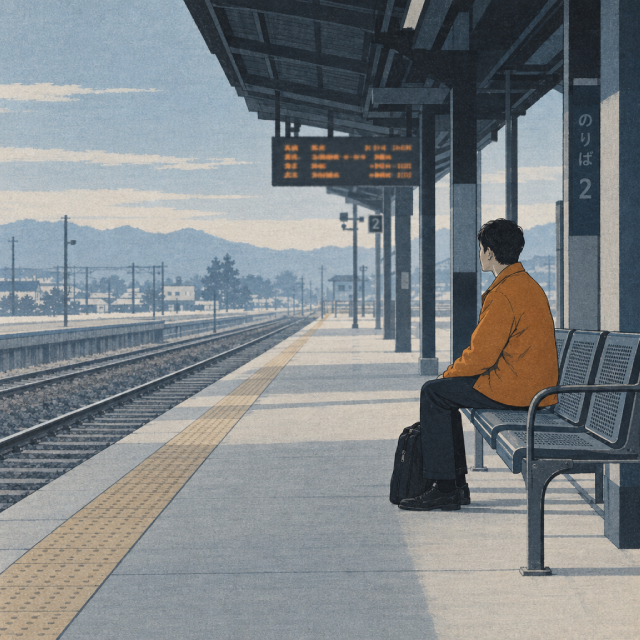
Stoic principle: events are neutral — it is the judgement we add to them that weighs.
The train was forty minutes late.
It was not a catastrophe. It was forty minutes — the length of a television episode, a coffee drunk too slowly, a phone call put off for three weeks. Julien Marais, thirty-eight, project manager at a company that manufactured seals for the automotive industry, stared at the departure board as though the number might change under the force of his concentration.
It did not change.
The problem was not the forty minutes. The problem was the five o'clock meeting, the client from Lyon who had already rescheduled twice, and the fact that Julien had chosen this particular train precisely because it arrived with a comfortable margin. A margin that had just vanished into something the railway company called, on the screen, an upstream disruption.
He took out his phone. He called his colleague Sandra, who was already there.
— Let Bertrand know I'll be late. Train.
— He's been here since noon, said Sandra. He seems to be in a reasonable mood.
— He always seems to be in a reasonable mood.
— True.
He hung up. He sat down on a cold metal bench. He set his bag between his feet.
Around him, people were responding to the delay in ways he observed, for want of anything better, the way one reads the news in a waiting room. A man in his sixties was speaking loudly into his phone while walking in circles, repeating at regular intervals that it was outrageous, that this only happened in France, and that last time it was exactly the same. A woman with a pushchair appeared not to have noticed. Two teenagers were playing something on their phones. A man in a suit was looking at his shoes.
Julien wondered what he himself appeared to be doing.
He appeared to be a man sitting on a bench, waiting for a train.
That was accurate.
The problem with the forty minutes — he was beginning to see it clearly now, with Sandra's call over and his phone put away — was that he had already added a great deal to them.
He had added the missed meeting, which had not yet been missed. He had added Bertrand's reaction, which he did not know. He had added the look his colleagues would give him, or would perhaps not give him. He had added a kind of general verdict on his ability to handle the unexpected, as though forty minutes of rail delay said something about him as a person.
The train, for its part, had added nothing. The train was late. That was the entirety of the fact.
He arrived in Lyon twenty-two minutes behind schedule. Bertrand was waiting in the meeting room with a coffee and the expression of someone who had spent the morning working through emails and was relieved to be offered something else.
— Train? he said.
— Train, said Julien.
— It happens. Sit down.
The meeting lasted an hour and a half. It ended with an agreement in principle that Julien had not anticipated and that Bertrand appeared to have decided upon before Julien had even opened his presentation. Leaving the building, in the lift, Julien realised he had no way of knowing whether arriving on time would have changed anything.
Perhaps yes. Perhaps no.
The meeting had taken place. The agreement was there. The rest was fiction.
On the train back, he watched the plain between Lyon and Paris scroll past — fields, pylons, the backs of animals in the late-afternoon light — and thought, without quite putting it into words, that he had spent forty minutes that morning living inside a version of events that had never occurred.
The return train was on time.
He did not notice.



