Introduction to Hegel’s Philosophy
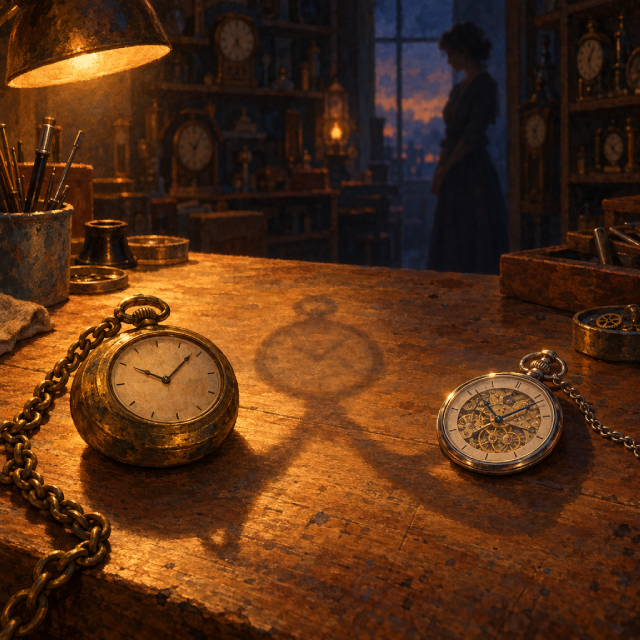
(I kept the same “watchmaking” situations as for Kant.)
If Kant is the one who teaches us to set the right rules, Hegel is the one who tells us: look, everything is in the process of becoming.
Where Kant seeks something solid and universal, Hegel looks at the world as a history in the making. We understand things not in isolation, but through their tensions, their contradictions, and their transformation. It is not a break, it is a living continuity.
I (two characters are right… but only partly)
One day, two customers came into the workshop almost at the same time. The first set a sturdy watch down on the table.
“It’s perfect,” he said. “Solid, reliable. It has never let me down.”
The second took out a slender, elegant watch.
“Mine is far superior,” he declared. “Precise, light, almost alive.”
They looked at each other, already at odds.
“Yours is crude.”
“Yours is fragile.”
Tomas studied the two objects. In its own way, each of them was right.
He took the sturdy watch first. It was stable, resilient, made to last. Then he examined the second: delicate, precise, almost sensitive to the slightest movement.
“Well?” asked the first man. “Which one is better?”
Tomas hesitated. He looked at Élise, who, as so often, did not answer. So he said slowly:
“If I had to choose… I would say that each one succeeds at something the other cannot.”
The two customers protested at once.
“You have to decide!”
“They can’t both be equally good!”
Voices rose. Tomas sensed that he couldn’t simply smooth over the conflict. He picked up the two watches again and, after a moment’s thought, said:
“What if the problem wasn’t choosing between them… but understanding what they could become?”
The two men fell silent.
“This one,” he said, pointing to the first, “could gain in finesse.”
“And this one,” he added, indicating the second, “could become more robust.”
He set the two watches side by side.
“And what if the best watch didn’t exist yet?”
A silence settled in. As if, suddenly, the question had changed. The two customers looked at their watches differently. Less as answers. More as stages. When they left the workshop, neither had entirely given up his opinion. But neither held it quite in the same way anymore.
Tomas remained thoughtful.
“That wasn’t just a disagreement,” he said.
Élise nodded.
“No. It was a movement.”
“As if… they needed each other to go further.”
Élise smiled. In the workshop, the watches kept ticking. Not in unison. But each in its own way searching for a time yet to come.
II (conflict brings forth something richer)
For some time now, Tomas had been working more slowly. Not because he doubted his hands, but because he doubted his choices.
One morning, Élise entrusted him with an important commission.
“A watch for someone leaving for a faraway place,” she said. “It must be reliable.”
Tomas nodded. But as he opened the case, he felt a hesitation. An idea came to him: to improve the mechanism slightly, to try something new. It would be bolder… perhaps better.
Then another thought took hold: What if it made the watch less dependable?
He sat motionless. On one side, what he knew. On the other, what he wanted to attempt.
“You’ve stopped,” Élise said gently.
Tomas sighed.
“I have two reasons… and they oppose each other.”
Élise came closer.
“Tell me.”
“If I stay cautious, the watch will be reliable.
If I innovate, it might be better.”
He looked up.
“But I can’t do both.”
Élise did not answer right away. Then she said:
“You believe you have to choose between them.”
Tomas frowned.
“Don’t I?”
She picked up a piece of the mechanism.
“And what if your problem wasn’t a choice… but a stage?”
He remained silent.
“You set security against improvement,” she went on. “But perhaps what you’re looking for… is a way of transforming them together.”
Tomas looked at the watch differently. No longer as a frozen dilemma, but as something to be made to evolve.
He went back to work. Even more slowly. He tested, adjusted, stepped back, started over.
He kept neither his initial idea, nor the boldness as it had first come to him.
But something else appeared. A slightly new mechanism, one that respected sturdiness… while improving it.
When he had finished, he gazed at the watch for a long time.
“It’s not what I had planned,” he said.
“No,” Élise replied. “It’s what you found.”
Tomas smiled faintly.
“So… the conflict wasn’t an obstacle.”
Élise gently shook her head.
“No. It was the work itself.”
In the workshop, nothing had changed. And yet, something had shifted. Not in the watch. In the way of thinking.
III (we transform ourselves by integrating what we have been)
One evening, as the workshop lay almost in shadow, Tomas stayed behind alone. All the watches had been repaired. Everything was in its place. And yet something troubled him. He looked at his hands. They were no longer those of the apprentice who had arrived long ago. They were steadier. Slower, too. He remembered his beginnings.
Back then, he had wanted to do well.
Then he had wanted to do right.
Then he had wanted to understand.
He felt as though he had been several people. And none of them corresponded quite to the one he had become.
Élise came in without a sound.
“Are you looking for something?” she asked.
Tomas hesitated.
“I’m wondering… whether I’m still the same.”
She came closer.
“What makes you say that?”
“I no longer think as I used to. I no longer decide in the same way. Even what I find "obvious" has changed.”
He paused.
“So… have I lost something? Or have I become someone else?”
Élise looked at an old watch sitting on the shelf.
“Look at this one,” she said.
Tomas picked it up.
“It has been repaired several times,” Élise continued. “Some of its parts are no longer original.”
“Then it’s no longer the same watch?”
Élise smiled slightly.
“And yet… it’s still itself.”
Tomas remained silent.
“What you were has not disappeared,” she said softly. “It’s what allowed you to become what you are.”
He thought it over.
“So… I’m neither quite the same… nor quite someone else.”
“Exactly.”
A long silence followed.
Then Tomas said:
“Then understanding oneself… isn’t finding oneself as one was.”
“No.”
“It’s accepting that one becomes… by changing.”
Élise nodded. In the darkened workshop, the watches kept on beating. Not as before. But not otherwise either. Simply… continuing their movement. And perhaps the self, deep down, is nothing other than this: something that never stops becoming, without ever ceasing to be.



