Cato of Utica — what cannot be bought
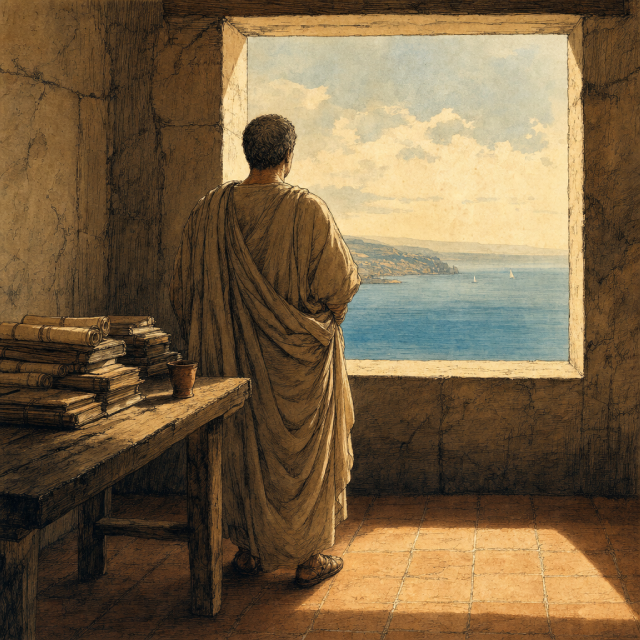
Marcus Porcius Cato Uticensis died at Utica on 12 April 46 BCE, the night following the departure of Caesar's emissary. He had spent the evening rereading Plato's Phaedo — Socrates' dialogue on the immortality of the soul — and refused the care his companions attempted to provide. Caesar published a pamphlet against him. Cicero wrote his eulogy. For two centuries, Romans debated which of the two had better understood what it meant to be a free man.
Utica, 46 BCE — An officer of Caesar reports what he witnessed.
We had been told he lived like a soldier. We assumed it was a manner of speaking.
It was not a manner of speaking.
Caesar had sent me ahead — not to negotiate, negotiation had long since closed, but to observe. To understand, he said, why this man refuses what every man eventually accepts. The pardon was offered. Generous, even, in Caesar's measure: property restored, honors preserved, the past erased by decree. He had only to extend his hand.
I arrived at Utica on the morning of the last day, without yet knowing it.
The house was not a senator's house. It was the house of a man who had camped in a city, as if he had told himself one day that he would not need to stay long, and who had been right for the wrong reasons. A few pieces of furniture. A table. Books — many books, arranged with care, the only objects that seemed to have been placed with intention. Everything else was functional. Not poor: functional. The difference matters. Poverty is a constraint. What I saw was a choice.
He received me himself, without a servant. This too was not affectation: his people came and went freely; some had left to join families they had in Africa, and he had let them go with their savings and his blessing, as if their freedom had always been his to give rather than to withhold.
He was not old. That was what struck me first. People speak of Cato as an ancient, a figure from republican times, a man who already belonged to a past that Caesar had just brought to a close. He was forty-nine. He had the hands of a man who had served, the eyes of a man who read too much and slept too little, and none of the marks that ambition ordinarily leaves on a face — that tension around the mouth, that permanent calculation in the gaze.
He had the look, simply, of someone who expected nothing.
I conveyed Caesar's offer. He listened without interrupting me, which was already unusual for a Roman senator.
— Caesar is generous, he said when I had finished.
His voice was level. Not cold — level. There is a difference.
— He is, I said. And the offer is sincere.
— I do not doubt it. Caesar is sincere in all his generosities. That is why they are so difficult to refuse without appearing ungrateful.
He rose, walked to the window. Outside, the sea. Utica is a city that watches the water as if waiting for something that will not return.
— What does Caesar believe I would lose, by accepting?
I had no prepared answer to that question. I had been briefed on arguments, counterarguments, likely points of resistance. No one had anticipated that he would frame it this way.
— Your property would be restored, I said. Your rank preserved.
— My property. — He repeated the words with something close to curious amusement, as if I had just named objects belonging to someone else. — I lived with little during the campaigns. I lived with little before the campaigns. Bread and olives nourish as well as Lucullus's feasts — they simply have the advantage of creating no dependency. One can do without what one has never learned to desire.
He turned back toward me.
— Tell Caesar I thank him. Tell him also that what he offers me, I already have — and what he cannot offer me, I will keep regardless.
I left without fully understanding what he meant. I understood that same evening, when the news crossed the city.
What he wished to keep was the one possession Caesar could neither grant nor take: the judgment he held of himself. The esteem of his own conscience. The Greeks would have said aidos — that interior thing which makes certain acts impossible not because they are forbidden, but because one could no longer face oneself afterward.
Caesar wept, it is said, upon learning of his death. I believe it. Caesar wept easily and sincerely. He wept for Pompey, he wept for Cato, he wept for every man he had been compelled to defeat in order to become what he was.
He never understood, I think, why Cato had chosen to die free rather than live pardoned.
He had never gone without anything. Perhaps that was why.