Diego Garcia
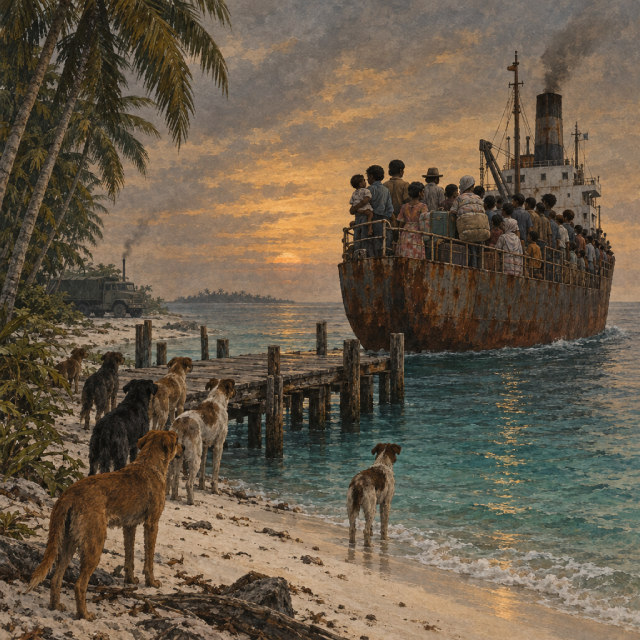
On the atoll, they don’t say "government"; they say "the Office." Josette Alexis watches her island gradually empty out, based on words chosen to mean nothing at all—"resettlement," "reorganization"—until, decades later, she learns that her entire people were nothing more than a clause in an agreement signed without their knowledge.
Indian Ocean, 1968-1973 — expulsion of the Chagossians
On the atoll, no one said “the government.” They said “the Bureau” — a distant entity, in London or Port Louis, whose decisions always arrived by the same route: a boat, a man in a suit, a sheet of paper read aloud in the square in front of the church.
Josette Alexis was thirty-two when the boat brought the announcement that would change everything, without her understanding, at the time, its real scope. They were told that the Oil Company — the one that had always run the coconut plantations, that paid the wages, that owned the only shop, the only school — was ceasing its activities. No reason given, other than a vague formula: “administrative reorganization of the region.” Josette had grown up shelling copra with her mother; her husband Pierre worked on the island’s fishing boats. They had never known any life but this one, nor wished to know another.
What followed was never presented as an expulsion. Softer words were used: “resettlement,” “relocation assistance.” Josette understood very early that these words described nothing real; they served only to make speakable what, stated bluntly, would have been unbearable even for those who decided it.
First, the supply boats were prevented from returning. Then the hospital was closed. Then, one morning, men armed with rifles rounded up the village dogs — hunting dogs, family pets, dogs that slept beneath the verandas — into the copra sheds, and killed them with truck exhaust fumes, in front of everyone, without any credible sanitary reason ever being given. Josette never forgot that engine noise that ran too long. She understood, that day, that the message was not meant for the dogs.
The Bureau finally announced that the entire island would be evacuated. No one’s opinion was asked. No village council was consulted. People were packed like freight — a few suitcases, no animals, no furniture — onto cargo ships that smelled of fuel oil and the cattle dung from their previous voyage. The crossing to Mauritius took days. Josette remembered vomiting on the deck, pressed against Pierre, while an old woman recited endlessly the names of her village’s streets, as if to keep from losing them.
In Port Louis, they were put ashore on the docks with no housing arranged, no real compensation, with a derisory sum meant to cover “resettlement expenses.” They were told to fend for themselves. Josette and Pierre settled in a tin-roofed shantytown called Cassis, where no one ever explained to them why their island had had to be emptied. The Mauritian newspapers barely spoke of them; they were called “the Ilois,” a word that, through being repeated without precision, came to designate less a people than an administrative inconvenience one would have liked to be rid of cleanly.
It was only decades later, through a newspaper article her daughter translated from English, that Josette finally learned the truth that no official had ever told her to her face: Diego Garcia, the largest island of the atoll, had been leased to the Americans to build a military base there. The evacuation of her people had been neither a sanitary necessity nor an economic reorganization. It had been a clause in an agreement between two governments, signed far from her, without a single Chagossian ever having sat at the negotiating table. The absurdity of this discovery did not make her cry out. She simply remained silent for a long while, the sheet of newspaper in her hands, as though the weight of the paper had suddenly doubled.
Josette never saw her island again. Year after year, she asked to be included on the return lists promised by successive rulings — British, then international — that acknowledged the injustice without ever truly repairing it. Each judicial victory seemed to be followed by a new administrative pretext delaying its practical application. She learned to stop hoping for a precise date, only to hope that the file would remain open, somewhere, once she was no longer there to carry it herself.
She kept a seashell, just one, picked up on the beach of her native village the evening before departure, slipped into her pocket almost by reflex rather than by deliberate feeling. She showed it to no one. She would sometimes take it out, in the evening, in the tin house in Cassis, set it on the table, and look at it as one looks at evidence — proof that a place had existed, that she had not dreamed an entire life before some bureau, somewhere, decided it had to end.
Her granddaughter, born in Mauritius, knew the atoll only through that seashell and through the Creole words Josette kept murmuring while cooking, words for fish and trees that neither of them had ever again seen with her own eyes. It was little. It was also all that remained.